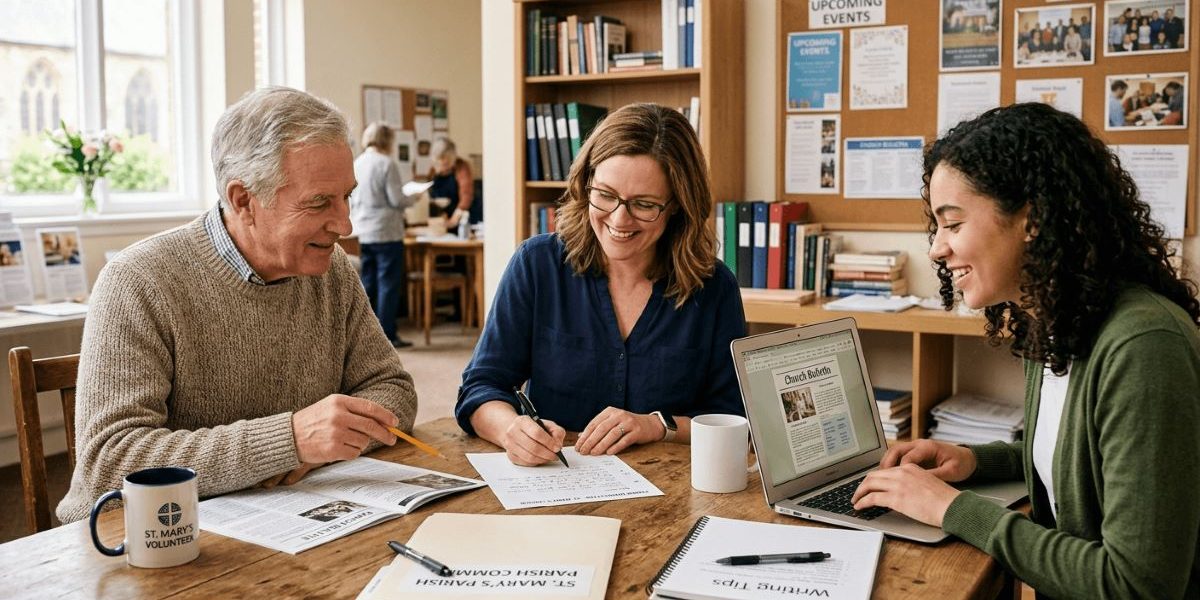
Every Sunday bulletin handed to a parishioner carries weight. It is not just a schedule. It represents the voice of your community. When a word is misspelled or a sentence makes no sense, people notice. And more often than not, the person who put that bulletin together was a volunteer giving up their free time to serve. That is admirable. But good intentions alone do not produce polished copy. The good news is that getting better at parish communication is very much a learnable skill, and it starts somewhere simpler than most people expect.
Parish volunteers who handle newsletters, bulletins, and social media posts often overlook one key skill: typing. Faster, more accurate typing means fewer errors in published content, less time correcting drafts, and more confidence when writing on behalf of your parish. Treating typing practice as part of service preparation is a small shift that produces real results.
Why Clear Writing Reflects Well on the Parish
Parish communication is public-facing. A misspelled name in the bulletin is embarrassing. A garbled event notice on Facebook can confuse families and lead to poor turnout. These are not catastrophic failures, but they add up. Over time, inconsistent or error-filled communication chips away at the credibility of the parish office and, by extension, the volunteers behind it.
Writing clearly and correctly shows respect for your readers. It signals that the information was prepared with care. For a faith community, that sense of care matters deeply. People entrust their parish with important moments in their lives, from baptisms to funerals. When they read the bulletin or check the parish website, they deserve content that is accurate and readable.
This is not about perfection for its own sake. It is about honouring the role. And that means taking the practical side of writing just as seriously as the spiritual motivation behind it.
The Hidden Gap in Volunteer Training
Most parishes do a great job training volunteers in pastoral care, event coordination, and liturgical roles. But almost none address the mechanics of writing. Volunteers are handed login credentials for a website or a newsletter platform and expected to figure things out. That works for some people. For others, it creates a slow, frustrating process full of typos and backtracking.
The gap is not confidence or commitment. It is often something very basic: typing fluency. A volunteer who types slowly and inaccurately will spend twice as long producing half the result. They will make more errors under time pressure. They will avoid writing altogether if they can.
Addressing this gap does not require expensive training or a tech background. It requires a willingness to practise a skill that most adults have never formally developed.
Building a Foundation With a Typing Assessment
Before you can improve, you need to know where you stand. That sounds obvious, but very few adult volunteers have ever measured their typing speed. They type every day without any sense of how efficient that typing actually is.
Taking a beginner typing assessment is the most accessible way to get a baseline. It takes a few minutes, requires no prior knowledge, and gives you a real number to work from. That number, your words per minute, tells you immediately whether your pace is likely to slow you down when producing parish content under time pressure.
Knowing your baseline changes how you approach practice. It removes the vague sense that you “should probably type faster” and replaces it with a concrete goal. It also tends to be motivating. Most volunteers are surprised by what a short, focused practice session does to their speed within just a few weeks.
When Errors Are the Real Problem, Not Speed
Some volunteers actually type at a reasonable pace. Their bottleneck is not how fast they go. It is how many corrections they need to make afterward. They produce a paragraph, re-read it, and find three typos. They post a social media update and spot a mistake only after it goes live. Speed is fine. Accuracy is not.
This is a very different problem, and it calls for a different solution. Rather than pushing to type faster, these volunteers need targeted work on precision. Accuracy drills train the fingers to hit the right keys consistently, slowing the muscle memory down until correct patterns become automatic. Once accuracy becomes second nature, speed naturally follows without sacrificing quality.
For parish communication specifically, accuracy matters more than pace. A newsletter does not need to be written in five minutes instead of ten. It needs to be correct. A misspelled name or a wrong date causes real confusion among real people planning their week around parish events.
Seven Habits That Help Volunteer Writers Produce Better Content
- Set a dedicated writing window. Even 20 minutes of focused work produces better results than writing in short, interrupted bursts throughout the day.
- Use a style reference. Keep a short document with your parish’s preferred spellings, capitalisation choices, and tone guidelines. Consistency builds credibility.
- Read aloud before publishing. Your ear catches errors your eyes miss. If a sentence stumbles when spoken, it needs to be rewritten.
- Draft, then step away. Return to your draft after a break. Fresh eyes catch mistakes that familiarity hides.
- Keep sentences short. Long, winding sentences confuse readers. Aim for one idea per sentence.
- Use plain language. Avoid jargon that might alienate newer parishioners or visitors unfamiliar with Catholic or Anglican terminology.
- Practice typing between tasks. Even five minutes of deliberate typing practice during a break adds up quickly over a month.
What Good Parish Communication Actually Looks Like
Good parish content is clear, warm, and accurate. It tells people what they need to know without burying the important details in a wall of text. It uses the right names. It lists the correct times. It communicates care without sounding stiff or corporate.
That standard is achievable for any volunteer. It does not require a journalism degree or a background in communications. It requires attention, practice, and a willingness to treat the writing itself as part of the ministry.
Here are the qualities that separate strong parish communication from weak communication:
- Accurate dates, names, and contact details every time
- A tone that feels personal and welcoming, not like a form letter
- Short paragraphs that are easy to skim
- Consistent formatting across bulletins and social posts
- No unexplained abbreviations or insider language
- A clear call to action when attendance or participation is needed
Making Typing Practice Feel Like Part of the Preparation
The mindset shift that helps most is treating typing practice the way a lector treats reading preparation. A good lector does not walk up to the ambo cold. They read through the passage beforehand. They practise the pronunciation of unfamiliar words. They prepare so that their delivery serves the congregation.
A volunteer writer can approach their role the same way. Preparing your hands and your fingers to type cleanly and quickly is not a vanity exercise. It is a form of service preparation. It respects the reader’s time and your parish’s public image.
Ten minutes of deliberate typing practice before sitting down to write a newsletter is not wasted time. It is warm-up time, just like any other skilled task.
“Parish volunteers carry the parish voice into the community. Every word they publish is a reflection of the values the community holds. Preparing to write well is not extra work. It is part of the calling.”
Getting Started This Week, Not Someday
There is a tendency to treat skill-building as something for a quieter season. After the Easter schedule. After the fundraising drive. After the summer holiday. That quieter season rarely arrives. The bulletin still needs to be done by Friday. The social media post still needs to go up before the event.
Starting small works better than waiting for the perfect moment. Take a baseline typing test this week. Spend a few minutes on precision drills before your next drafting session. Ask your parish communications coordinator if there is a shared style guide you can reference.
Small, consistent steps build real skill over time. The volunteer who practises for five minutes three times a week will write with noticeably more confidence within a month. And that confidence shows in the final product.
Writing Well Is an Act of Service
Parish volunteers give an enormous amount of themselves. Time, energy, talent. The writing that supports parish communication deserves the same thoughtfulness. Taking a few steps to improve typing fluency and accuracy is not about becoming a professional writer. It is about showing up fully for the role.
When the bulletin is clear, the congregation is informed. When the social media post is accurate, the event is well-attended. When the newsletter reflects care in every sentence, readers feel the warmth of the community behind it. That is what good volunteer communication does. And it starts with being willing to practise.